We've serviced enough Central Florida homes to know this firsthand: smart thermostats track your HVAC runtime — they don't actually inspect your 12x25x4 filter.
That distinction matters more here than almost anywhere else in the country. Florida's year-round cooling season means your system logs two to three times the runtime hours of a northern home. A thermostat counting down a generic 90-day timer has no idea your filter already pulled a full season's worth of oak pollen, humidity, and construction dust from Osceola County subdivisions in half that time.
What we've found in homes across Central Florida: the filter countdown and the filter's actual condition rarely match. Here's how to use smart thermostat monitoring correctly — and where to trust your own eyes over your thermostat's timer.
TL;DR Quick Answers
12x25x4 Air Filters
A 12x25x4 air filter is a 4-inch deep media filter designed to capture more contaminants, last longer, and protect HVAC systems more effectively than standard 1-inch filters.
What the numbers mean:
12x25 = filter dimensions in inches (height x width)
x4 = 4-inch media depth for expanded filtration capacity
What makes a 12x25x4 different:
Holds significantly more contaminant before restricting airflow
Lasts 90 days under standard conditions — shorter in high-humidity or high-pollen environments like Central Florida
Requires a dedicated media cabinet — does not fit standard 1-inch filter slots
Recommended MERV ratings for a 12x25x4:
MERV 8 — standard household filtration
MERV 11 — pets or mild allergy concerns
MERV 13 — asthma, serious allergies, or respiratory conditions
When to replace a 12x25x4:
Every 60 days with pets or allergy sufferers
Every 90 days for standard year-round households
Monthly visual check recommended regardless of schedule — hold the filter to a light source and inspect the center media, not just the edges
Bottom line: A 12x25x4 filter is one of the most effective residential filtration upgrades available — but only when sized to the right system, matched to the right MERV rating, and replaced on a schedule based on actual filter condition, not just a timer.
Top Takeaways
Smart thermostats monitor runtime — not filter conditions. They count hours, not contaminant load. In Central Florida's year-round cooling season, that gap matters.
A 12x25x4 can look fine and still be failing. Deep media hides loading in the center pleats. The edges look clean long after airflow restriction has already begun.
A loaded filter costs you money before it stops your system. It forces harder blower operation, longer runtime, and higher utility bills — symptoms that often get misread as equipment failure.
Central Florida's climate shrinks the gap between reminder and real replacement needs. Year-round humidity, oak pollen, and sealed homes accelerate loading faster than a generic 90-day countdown track.
Thirty seconds beats every app. Pull the filter. Hold it to light. Check the center. That one habit — backed by your thermostat reminder as a starting point — is still the most reliable monitoring system available.
How Smart Thermostats Actually Track Your 12x25x4 Filter
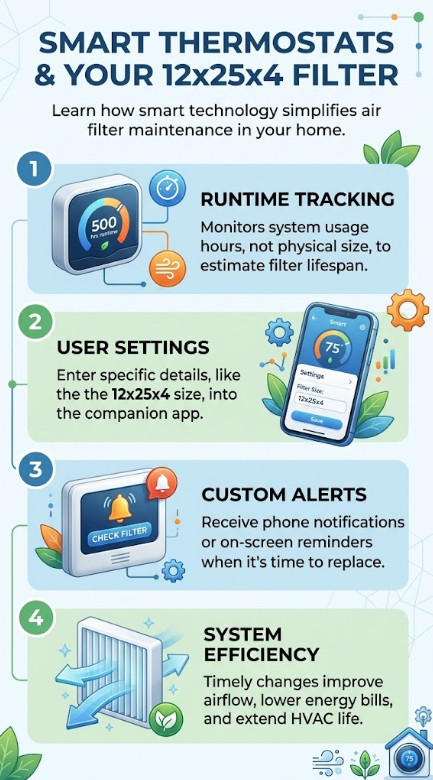
Smart thermostats don't see your filter. They count hours.
Devices like the Nest and Ecobee use total system runtime to trigger a filter change reminder — nothing more. Once your HVAC logs a preset number of operating hours, the thermostat flags the filter as due. It has no sensor measuring airflow restriction, particle load, or actual filter condition.
For a standard 1-inch filter, that limitation is manageable. For a thick 4-inch filter like the 12x25x4, it creates a real blind spot.
Why 4-Inch Filters Change the Monitoring Equation
A 12x25x4 filter holds significantly more contaminants than a 1-inch filter before reaching restriction levels — that's the whole point of the deeper media bed. Most smart thermostat filter timers are factory-set for thinner filters on shorter replacement cycles.
What we see in Central Florida homes is this: homeowners with 4-inch filters get a change reminder far too early. The filter still has useful life left, but the timer doesn't know that. Conversely, in high-pollen or high-dust households — think homes near construction corridors in St. Cloud or Kissimmee — the filter can load up well before the timer counts down.
The thermostat is making a generalized guess. Your home's air quality situation is specific.
What Smart Thermostats Do Well — and Where to Fill the Gaps
Used correctly, smart thermostat reminders serve one useful purpose: they make sure you never completely forget your filter. That's a low bar, but it matters.
Where they fall short:
They can't detect a filter clogged early by a heavy pet dander or renovation dust event
They don't account for Florida's extended cooling season, which compresses runtime hours into far fewer calendar months
They don't adjust for MERV rating differences between filter types
They won't alert you when elevated humidity has caused moisture to accelerate filter loading
From our experience servicing homes across Central Florida, the most reliable approach combines smart thermostat alerts with a simple monthly visual check. Hold the filter up to light. If you can't see light passing through the media clearly, it's time — regardless of what the timer says.
Setting Your Smart Thermostat Filter Reminder for a 12x25x4
Most smart thermostats allow you to manually adjust the filter reminder interval. For a 12x25x4 filter in a Central Florida home:
Homes with pets or allergy sufferers: set reminders every 60 days
Standard household with year-round AC use: every 90 days
Vacation homes or lightly occupied properties: every 6 months, with a visual check before extended use
Use the thermostat alert as your backup reminder. Use your eyes as the first line of defense.
When to Stop Relying on the Timer Entirely
There are situations where smart thermostat monitoring simply isn't enough and shouldn't be trusted as your primary indicator:
After a renovation, remodel, or major landscaping project near your home
During Central Florida's oak pollen season when airborne particle loads spike
If a household member has developed new respiratory symptoms
If your energy bills have risen without a clear explanation — restricted airflow from a loaded filter forces your blower motor to work harder
In these cases, check the 12x25x4 immediately. A filter that looks clean at the edges can be deeply loaded in the center media pleats where you can't easily see without pulling it fully.
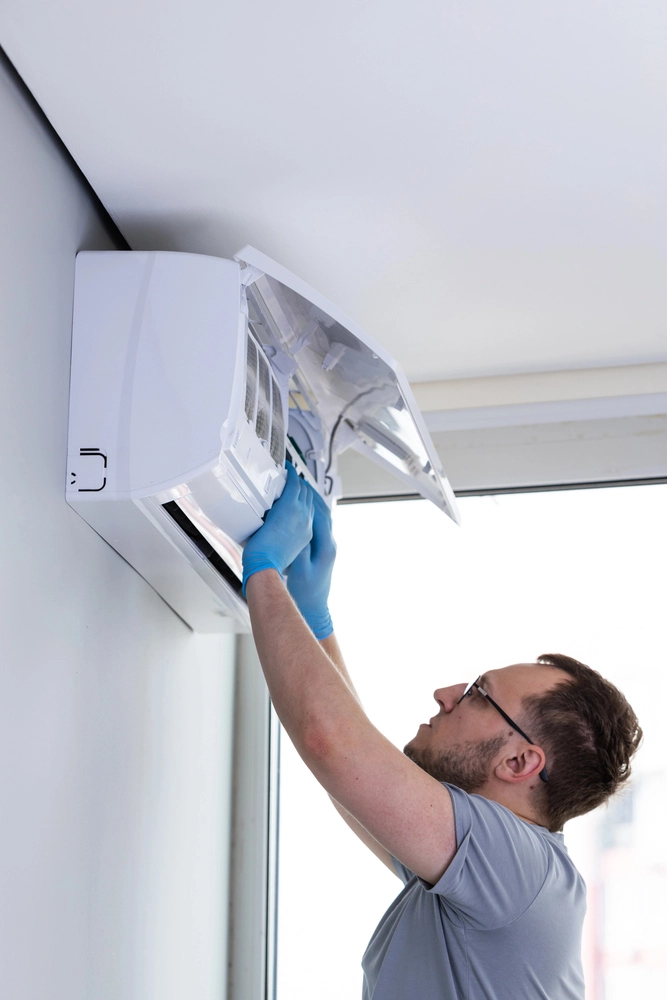
"After servicing Central Florida homes for years, the pattern is always the same — the homeowners most surprised by a loaded 12x25x4 filter are the ones who trusted their thermostat's reminder over their own eyes. A smart thermostat is a useful tool, but it was never designed to replace the 30 seconds it takes to pull your filter and actually look at it."
7 Resources We Actually Use When Advising Central Florida Homeowners on 12x25x4 Air Filters
We're air-obsessed — that means we don't just sell filters, we stay current on the science, standards, and health data behind them. These are the authoritative resources we reference when helping our neighbors make smarter decisions about their home's air quality and HVAC protection.
1. Start Here to Understand What Your 12x25x4 Filter Is — and Isn't — Doing for Your Air
Source: U.S. Environmental Protection Agency
This is the resource we point homeowners to first when they're genuinely confused about filter ratings and what different efficiency levels actually protect against. The EPA breaks it down clearly, without the marketing spin you'll find on most filter packaging.
What you'll learn: How to evaluate HVAC filter performance, what MERV levels mean for your household, and how to match filter capability to your family's actual health needs.
Read it here: https://www.epa.gov/indoor-air-quality-iaq/guide-air-cleaners-home
2. Don't Buy Another Filter Until You Understand This Number on the Box
Source: U.S. Environmental Protection Agency
We've seen too many Central Florida homeowners buy a 12x25x4 filter based on price alone, without understanding that the MERV rating is the only number that actually tells you how well it's protecting your family. The EPA explains it in plain language — no jargon, no upsell.
What you'll learn: What the MERV scale measures, how ratings are determined, and why a higher number doesn't always mean the right choice for your specific HVAC system.
Read it here: https://www.epa.gov/indoor-air-quality-iaq/what-merv-rating
3. The Invisible Reality of What's Floating Through Your Central Florida Home
Source: U.S. Environmental Protection Agency
One of the things we talk about most with our neighbors is this: indoor air is often two to five times more polluted than the air outside. Here in Central Florida — with year-round humidity, oak pollen seasons, and homes that run AC constantly — that number matters. This EPA overview makes the invisible visible in a way that changes how you think about filter maintenance.
What you'll learn: The most common indoor air pollutants, their sources, and the health data behind why consistent filtration isn't optional for families in our climate.
Read it here: https://www.epa.gov/report-environment/indoor-air-quality
4. A Clogged 12x25x4 Filter Is Quietly Raising Your Power Bill Every Month
Source: U.S. Department of Energy / ENERGY STAR
In our experience servicing homes across Central Florida, some of the highest utility bills we've seen weren't caused by an aging system — they were caused by a filter that should have been changed weeks earlier. The Department of Energy puts real numbers to something we see on service calls regularly: a dirty filter can increase your HVAC's energy consumption by up to 15%.
What you'll learn: How filter maintenance directly impacts energy efficiency, DOE-recommended replacement intervals, and what proper airflow means for your system's long-term health.
Read it here: https://www.energystar.gov/saveathome/heating-cooling
5. Why the Right Filter Is a Family Health Decision, Not Just a Home Maintenance Task
Source: U.S. Centers for Disease Control and Prevention
We genuinely care about the families we serve — and that means being honest about what's at stake when a filter goes unchanged too long. The CDC's data on fine particle pollution and respiratory health is a sobering reminder that air filtration isn't about keeping your equipment clean. It's about protecting the people breathing that air every day.
What you'll learn: How PM2.5 and PM10 particles affect respiratory and cardiovascular health, which household members face the highest risk, and what that means for your filtration decisions.
Read it here: https://www.cdc.gov/air-quality/pollutants/index.html
6. The Science Behind Every MERV Rating — What Filter Manufacturers Must Prove Before They Can Put a Number on the Box
Source: American Society of Heating, Refrigerating and Air-Conditioning Engineers (ASHRAE)
After manufacturing filters for over a decade, we know that not all MERV claims are equal. ASHRAE Standard 52.2 is the standardized laboratory test every rated filter must pass — and understanding how the test works helps you spot the difference between a filter that performs and one that just prints a good-looking number on the frame.
What you'll learn: How air filters are tested across 12 particle size ranges, what minimum efficiency reporting actually measures, and why this standard is the only objective basis for comparing 12x25x4 filters side by side.
Read it here: https://www.ashrae.org/File%20Library/Technical%20Resources/Technical%20FAQs/TC-02.04-FAQ-112.pdf
7. Match Your 12x25x4 to Your Household — Not Just Your Filter Slot
Source: Filterbuy
This is the resource we built specifically for homeowners who know they need a 12x25x4 but aren't sure whether MERV 8, 11, or 13 is the right call for their situation. The answer depends on pets, allergies, household size, and — especially here in Central Florida — how many months per year your system is running at full capacity. We wrote this guide to make that decision straightforward.
What you'll learn: A side-by-side breakdown of MERV 8, 11, and 13 performance differences, who each rating is best suited for, and how to choose the right filter without over-restricting your system's airflow.
Read it here: https://filterbuy.com/resources/air-filter-basics/which-merv-rating-should-I-use/
The Numbers Behind Why We Take Filter Maintenance So Seriously
We don't cite statistics to sound authoritative. We cite them because they confirm what we already see on every service call.
Sealed Homes Concentrate What a Loaded Filter Can't Catch
Americans spend approximately 90% of their time indoors, where pollutant concentrations are often 2 to 5 times higher than outdoor levels.
— U.S. Environmental Protection Agency https://www.epa.gov/report-environment/indoor-air-quality
That number hits differently in Central Florida. Here's why:
Northern homes get months of open windows and natural air exchange.
Central Florida homes stay sealed for 10 to 11 months a year.
Every contaminant that enters your home recirculates until your filter removes it.
We've pulled 12x25x4 filters from homes where the owner felt the air was fine. The filter told a different story. What you can't smell or see is often accumulating the fastest. Your filter isn't optional equipment. It's your home's only consistent defense against air that has nowhere else to go.
The Filter You Postpone Is Costing You More Than You Think
Nearly half of the energy used in your home goes to heating and cooling. A dirty filter will slow down air flow and make the system work harder — wasting energy.
— ENERGY STAR / U.S. Department of Energy https://www.energystar.gov/saveathome/heating-cooling
We've diagnosed this exact problem dozens of times. The homeowner calls about a rising utility bill. The system isn't failing. It's suffocating. Here's what a loaded 12x25x4 quietly does:
Forces the blower motor to work harder to pull air through restricted media.
Extends system runtime and compressor cycling.
Drives up energy costs in ways that mimic equipment age or refrigerant loss.
The 4-inch filter creates a specific trap. It holds far more contaminants before looking visibly dirty — so homeowners assume it still has life. But the energy penalty starts long before the filter looks obviously spent. The homes with the most dramatic utility bill improvements after a filter change are almost always the ones where the timer ran past the real replacement window.
What Your Filter Captures Is Exactly What Triggers Asthma Attacks
Indoor environmental factors — including dust mites, mold, cockroaches, pet dander, and secondhand smoke — can cause, trigger, or exacerbate asthma symptoms.
— U.S. Environmental Protection Agency, Asthma Facts https://www.epa.gov/sites/default/files/2021-04/documents/asthma_fact_sheet.pdf
Families managing respiratory conditions usually track outdoor triggers carefully — pollen counts, ozone days, air quality alerts. What they often miss is the indoor picture. Every trigger on that EPA list is exactly what a properly rated 12x25x4 captures before it recirculates. In Central Florida, those risks are amplified:
Dust mites thrive in Florida's year-round humidity.
Mold spores are a constant concern in a climate that rarely drops below 50% relative humidity.
Pet dander accumulates faster when animals seek cool indoor air as aggressively as their owners do.
We've serviced homes where a child's asthma had worsened for weeks with no clear cause. The filter was so overloaded it had started allowing bypass — pulling air around the media instead of through it. No app flagged it. No thermostat alert fired. It took a visual inspection to find what was quietly recirculating through the home. For these families, filter maintenance isn't a comfort issue. It's health management.
Our Final Thought — Smart Thermostats Are a Tool, Not a Guardian
Smart thermostats are impressive technology. We recommend them. We install them. We configure them for Central Florida homeowners every week.
But here's the opinion we've formed after servicing thousands of local homes — one you won't find in any thermostat manufacturer's marketing materials:
The smarter your home gets, the easier it becomes to stop paying attention to it.
Automation creates confidence. Confidence creates complacency. And in a subtropical climate where your HVAC runs nearly year-round, complacency is where filter problems quietly take root.
What This Page Comes Down To
A 12x25x4 filter is one of the hardest-working components in your home. It operates in silence. It doesn't send alerts. It doesn't appear on your smart home dashboard.
In Central Florida's conditions, a runtime-based reminder has real limits. Here's what we've observed consistently across our service area:
Homeowners with smart thermostats often change filters less frequently — because the reminder created a false finish line.
A 12x25x4 can look acceptable at the edges while deeply loaded in the center pleats where airflow matters most.
The symptoms of a failing filter — rising utility bills, reduced airflow, worsening allergy symptoms — rarely appear until the problem is already weeks old.
The Perspective We'd Offer Any Central Florida Homeowner
Use your smart thermostat's filter reminder as a starting point, not a deadline. Then add one simple habit:
Pull the filter once a month.
Hold it toward a light source.
Check the center media — not just the edges.
That 30-second inspection is still the most reliable filter diagnostic available. No app replicates it.
We've spent years obsessing over indoor air quality from both sides — as filter manufacturers and as local HVAC professionals seeing real results in real Central Florida homes. We keep arriving at the same conclusion:
The best filter monitoring system in your home is still an informed homeowner who knows what to look for.
A smart thermostat tells you when time has passed. A visual inspection tells you what actually happened inside your home during that time. Both matter. Neither replaces the other.
That's not a knock on technology. It's an argument for using it wisely — the same guidance we'd give a neighbor standing in their own hallway asking us what to do.
FAQ on 12x25x4 Air Filters
Q: How often should I replace a 12x25x4 air filter?
A: The 90-day guideline is a starting point — not a guarantee. Central Florida's climate changes the equation. Here's how we advise local homeowners:
Pets or allergy sufferers: every 60 days
Standard year-round household: every 90 days
Lightly occupied or vacation homes: every 6 months with a visual check before extended use
Conditions that shorten the window faster than any timer tracks:
Oak pollen season
Recent home renovation or remodel
Stretches of high humidity
Increased household occupancy
We've pulled 12x25x4 filters for 60 days that looked like they'd been in for six months. The timer gives you a starting point. The filter gives you the answer.
Q: What does the 4-inch depth of a 12x25x4 filter actually do?
A: Deeper media means dramatically more filtration capacity in the same filter footprint. The practical benefits:
More particles captured per air pass
Longer filter life before airflow restriction becomes a problem
Fewer replacements compared to a 1-inch filter in the same slot size
The insight most product descriptions skip: that extra capacity creates a blind spot. The center pleats fill long before the edges look dirty. A quick edge check won't catch it. Always hold the filter toward a light source and look through it — not just at it.
Q: What MERV rating should I use for a 12x25x4 air filter?
A: Start with your household — not the packaging. Here's how we break it down:
MERV 8: Solid baseline for standard households. Captures dust, pollen, and mold spores without stressing most systems.
MERV 11: Right step up for homes with pets or mild allergy concerns.
MERV 13: Recommended for households managing asthma, serious allergies, or respiratory conditions.
One caution we always include:
Higher MERV ratings increase airflow resistance.
Not every system handles that equally.
A mismatched MERV rating can create more blower strain than the filtration improvement is worth.
When in doubt, confirm with your HVAC technician before upgrading.
Q: Will a 12x25x4 air filter fit my HVAC system if the slot currently holds a 1-inch filter?
A: No — not without the right housing. A 4-inch filter requires a media cabinet built to that depth. Forcing one into a 1-inch slot:
Restricts airflow significantly
Strains the blower motor
Cancels out the benefits of the thicker filter
The good news: many Central Florida HVAC systems can be retrofitted with a proper media cabinet. What that upgrade delivers over time:
Improved filtration capacity
Extended replacement intervals
Reduced system strain in a climate with year-round operation
Have a qualified technician assess your return air cabinet first. Done correctly, it's one of the better long-term investments we recommend to local homeowners.
Q: Can I use a smart thermostat to track when my 12x25x4 air filter needs replacing?
A: Use it as a backup — not a primary system. Here's why that distinction matters for a 4-inch filter specifically.
Smart thermostats track runtime hours only. They cannot detect:
Airflow restriction
Actual particle load on the filter media
Humidity-accelerated loading
Dust spikes from renovation or heavy pollen events
For a 12x25x4, that limitation compounds. Deeper media holds more contaminants before triggering visible restriction. The gap between "the app says it's fine" and "the filter is actually loaded" is wider than it would be with a 1-inch filter.
The approach that works:
Set your thermostat reminder as a baseline alert.
Pull the filter monthly and hold it to a light source.
Check the center media — not just the edges.
Adjust your replacement schedule based on what you see, not what the app says.
That habit takes 30 seconds a month. No app replaces it.
Your Smart Thermostat Can't Change Your 12x25x4 Filter — But the Right One Makes All the Difference
Shop our full selection of 12x25x4 air filters and find the right MERV rating for your Central Florida home in minutes. Order today and get your filter delivered directly to your door — so the only thing left to do is swap it in.Learn more about HVAC Care from one of our HVAC solutions branches…
Filterbuy HVAC Solutions - Weston FL
2573 Mayfair Lane Weston FL 33327
(754) 296-3528